
Countries with the Most White-Collar Crime
Blog post description.
George Tannous, PhD
4/1/20262 min read

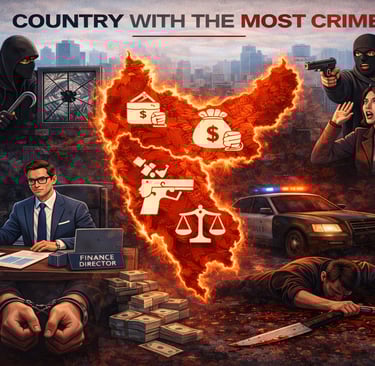
Countries with the Most White-Collar Crime
White-collar crime is a global issue that affects economies, governments, and individuals across the world. Unlike violent crimes, white-collar crimes are typically non-violent and financially motivated, including fraud, embezzlement, bribery, insider trading, and money laundering. While it is difficult to measure exactly which countries have the most white-collar crime—because many cases go unreported or undetected—certain nations are often associated with higher levels due to factors such as economic size, regulatory systems, and levels of corruption.
One of the countries frequently mentioned in discussions of white-collar crime is the United States. As the world’s largest economy, the U.S. has a vast financial system and numerous corporations, which can create more opportunities for financial misconduct. High-profile cases, such as corporate fraud scandals involving companies like Enron and WorldCom, have highlighted how white-collar crime can occur at the highest levels of business. However, the U.S. also has strong regulatory agencies, such as the Securities and Exchange Commission (SEC), which actively investigate and prosecute these crimes.
China is another country often associated with white-collar crime, particularly due to its rapid economic growth and expanding business sector. Cases involving corruption, bribery, and financial fraud have been widely reported. The Chinese government has launched anti-corruption campaigns in recent years, targeting both government officials and business leaders. Despite these efforts, the scale of the economy and the complexity of its systems make it challenging to eliminate such crimes entirely.
Russia is also commonly linked to high levels of white-collar crime, especially in areas such as money laundering, corruption, and financial fraud. Weak regulatory enforcement and political factors have sometimes allowed these crimes to persist. Organized crime networks have also played a role in facilitating financial crimes, both domestically and internationally.
In Europe, countries like Germany, the United Kingdom, and Italy have experienced notable cases of white-collar crime. The United Kingdom, as a global financial hub, has faced issues with banking fraud and money laundering. Italy has long struggled with corruption and financial crimes linked to organized crime groups such as the Mafia. Germany, while generally having strong regulations, has also seen corporate scandals, such as the Volkswagen emissions scandal, which involved deceptive practices.
Developing countries are not immune to white-collar crime either. In nations where governance structures are weaker or corruption is more widespread, such as Nigeria or Brazil, financial crimes can be more prevalent. These may include bribery, embezzlement of public funds, and large-scale fraud schemes. Limited resources for enforcement and oversight can make it harder to detect and prosecute offenders.
It is important to note that the prevalence of white-collar crime does not necessarily mean a country is more “criminal” than others. In many cases, countries with stronger legal systems may report more incidents simply because they are better at detecting and documenting them. Conversely, countries with weaker systems may have significant levels of crime that go unnoticed.
In conclusion, white-collar crime exists in countries all over the world, but it is often more visible in nations with large economies, complex financial systems, or higher levels of corruption. The United States, China, Russia, and several European and developing countries all face challenges related to these crimes. Addressing white-collar crime requires strong legal frameworks, transparency, and international cooperation to ensure accountability and protect economic stability.
Help
Support for your journey beyond incarceration
Contact
Connect
george@gtannous.org
1-818-512-8125
© 2026. All rights reserved.